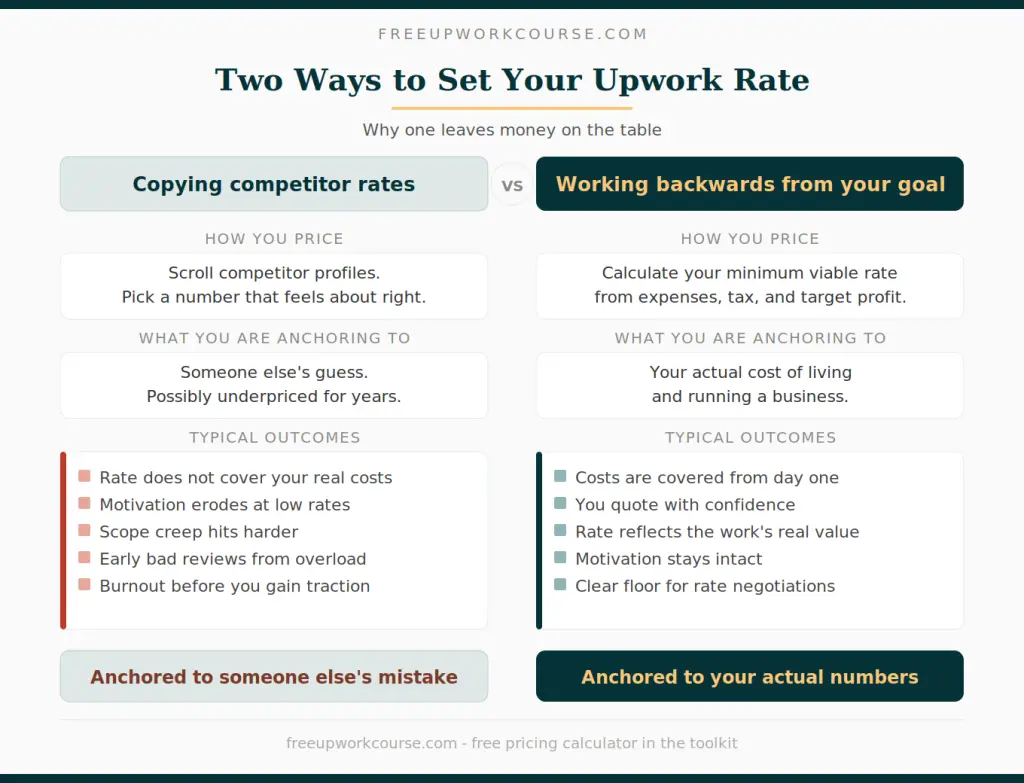
Most new freelancers set their Upwork rate the same way: they open a few competitor profiles, find a number that looks reasonable, and go with something similar. It feels like research. It is not.
What you are actually doing is anchoring your income to someone else’s guess. And on a platform where underpricing is the norm, copying the market means starting from the wrong number before you have written a single proposal.
This guide gives you a formula to work backwards from what you need to earn, accounting for Upwork’s service fee, self-employment taxes, and the billable hours reality that most pricing guides conveniently skip. By the end, you will have a minimum viable rate you can quote with confidence, and a clear method for adjusting it as you build your track record.
Why Copying Competitor Rates Is a Trap
Upwork profiles show public hourly rates. It is tempting to use them as a benchmark. The problem is that those rates tell you almost nothing useful.
A profile charging $15/hour might belong to a highly experienced freelancer from a lower cost-of-living country pricing competitively for their market. It might belong to someone who set their rate three years ago and never updated it. It might belong to someone who is actively losing money on every job and burning out within six months.
None of those situations apply to you, and none of them tell you what you need to charge to make freelancing financially sustainable.
Upwork Has a Race-to-the-Bottom Problem
Upwork has a reputation as a cheap platform. That reputation did not appear from nowhere. There are over 18 million registered freelancers on the platform. A significant portion of them have never calculated what they actually need to earn. They arrived, looked at what others were charging, went slightly lower to seem competitive, and called it a pricing strategy. Multiply that across millions of profiles and you get systematic underpricing built into the market itself.
This matters to you for two reasons. First, the rates you see are not a reliable signal of what the market can bear. They are a signal of what other freelancers guessed. Second, joining that race has a cost that goes beyond the obvious one of earning less money.
There is one legitimate exception. When you are brand new to the platform and have no reviews, no Job Success Score, and no track record for clients to evaluate, taking on one or two projects at a deliberately competitive rate makes sense. Think of it as a client acquisition cost rather than your actual rate. You are not pricing the work. You are buying a testimonial and a score to build on. Once you have two or three solid reviews, raise your rate. That first below-market contract was the investment. Every one after it at that rate is a loss.
Beyond those first few jobs, underpricing yourself consistently has consequences that go further than your bank balance. When work is priced below what it genuinely costs you, other things start to compete with it. A heavy workload at a rate that does not feel worth it means that contract is the first one to slip. Other priorities take over. Deadlines get deprioritised. This is not a character flaw. It is a predictable outcome of the economics.
The risk profile of this is very different depending on where you are in your career. When you are just starting out, a poor early review is close to fatal. Job Success Score and client feedback carry significant weight in how Upwork surfaces your profile, and a low score in your first few contracts is genuinely difficult to recover from. When you are more established, the damage is slower but still real: chronic underpricing quietly erodes motivation, and that eventually shows up in the quality of what you deliver, even when you are trying not to let it.
Set a rate that makes you want to do the work well. That is not idealism. It is risk management.
Step 1: Calculate Your Minimum Viable Rate
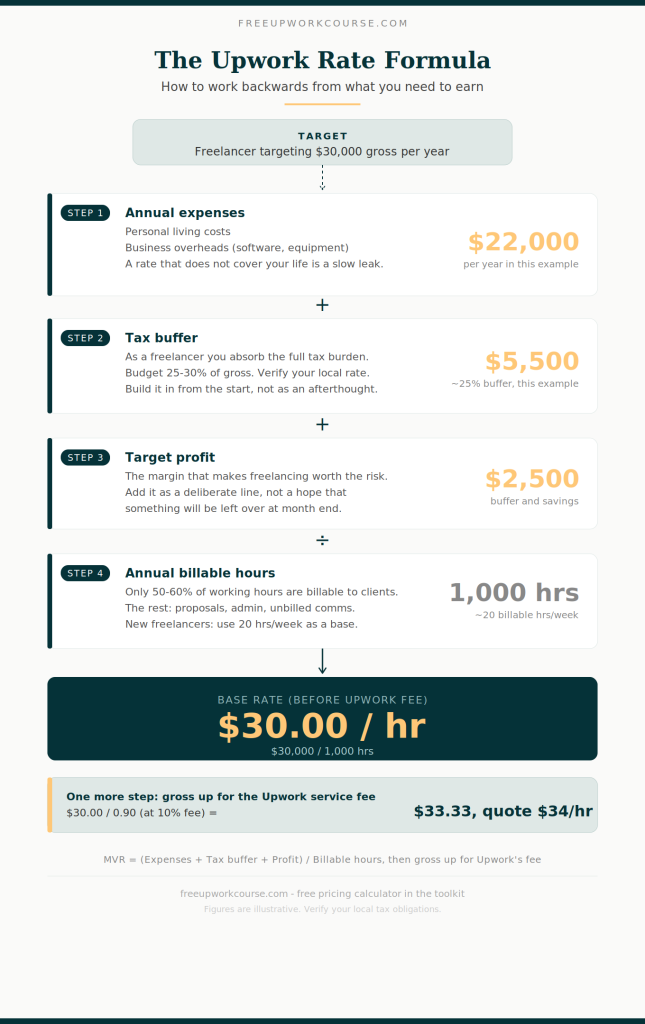
Your minimum viable rate (MVR) is the floor: the rate below which you are effectively paying to work. Everything above it is where profit lives. The formula has four inputs:
MVR = (Annual expenses + Tax buffer + Target profit) ÷ Annual billable hours
Here is what each input means in practice.
Annual Expenses
Add up everything the business needs to pay for over 12 months. This includes two categories:
- Personal living costs: rent or mortgage, food, transport, healthcare, utilities, savings, and any debt repayments
- Business costs: software subscriptions, equipment, professional development, accounting, and any marketing
Be honest here. A rate that does not cover your actual life is not a rate. It is a slow leak.
Tax Buffer
When you are employed, your employer handles a portion of your tax contributions on your behalf. As a freelancer, you absorb all of it. The exact obligations vary by country, but the principle is universal: self-employment comes with a higher effective tax burden than most people expect when they make the switch.
Whatever your local tax rate, budget for it as a concrete line item in this calculation rather than hoping something is left over at the end of the year. A working assumption of 25–30% of gross income is a reasonable starting buffer for most freelancers, but check your local requirements and speak to an accountant if you are unsure. Getting this wrong means your rate looks profitable on paper while quietly draining your bank account.
Target Profit
Your expenses represent survival. Target profit is the margin above that: the number that makes freelancing worth the risk and gives you a buffer for slow months, equipment upgrades, and future rate increases. Add it as a separate line, not as a hope that something will be left over at the end of the month.
Annual Billable Hours
This is where most pricing calculations go wrong. A standard working year is roughly 2,000 hours (40 hours per week, 50 weeks). But only 50–60% of those hours are typically billable to clients. The rest goes to writing proposals, admin, professional development, and the unpaid communication that surrounds every project.
For a new Upwork freelancer, 20–25 billable hours per week is a realistic target while you are building your profile and pipeline. That gives you approximately 1,000–1,200 billable hours per year. Use the lower end until your conversion rate on proposals improves.
A Worked Example: Running the Numbers
Here is the formula applied to a realistic beginner scenario — a freelancer targeting $30,000 gross per year. Adjust the inputs for your own situation.
These figures are illustrative. Your actual expenses, tax obligations, and billable hours will vary.
| Input | Example figure |
| Annual personal expenses | $20,000 ($1,667/month) |
| Annual business costs | $2,000 (software, equipment) |
| Tax buffer (25%) | $5,500 |
| Target profit | $2,500 |
| Total annual income requirement | $30,000 |
| Realistic billable hours/year | 1,000 hours (approx. 20/week) |
| Base hourly rate (before Upwork fee) | $30,000 ÷ 1,000 = $30.00/hr |
Step 2: Gross Up for the Upwork Service Fee
The base rate above is what needs to land in your account. But Upwork deducts its service fee before you see the money, so the rate you quote to clients needs to be higher than your base rate.
As of 2026, Upwork’s service fee ranges from 0% to 15% per contract, with most freelancers seeing approximately 10%. The exact rate is shown before you submit a proposal.
To calculate the gross rate you need to quote, divide your target net rate by (1 minus the fee rate):
Gross rate to quote = Target net rate ÷ (1 − Upwork fee rate)
Applied to the worked example above:
- Target net rate: $30.00/hr
- Upwork fee: 10%
- Gross rate to quote: $30.00 ÷ 0.90 = $33.33/hr, round to $34/hr
Always check the fee rate shown on your specific contract. Do not assume 10%. The rate shown at proposal submission is the rate that applies.
Step 3: Sense-Check Against the Market
Your minimum viable rate is the floor. The market rate for your skill is the ceiling. Before you lock in your profile rate, spend 20 minutes on Upwork searching for freelancers who do similar work at a similar level of experience. Look at people who have a comparable background to yours, not the top earners with hundreds of reviews and years of platform history. Check what they are charging and, where you can see it, what clients have actually paid them.
You are not looking to copy a number. You are checking whether your calculation produces something that is in the same universe as what the market looks like. If your formula gives you $34/hr and every comparable profile you find is charging $15-$20/hr, that is useful information. It means either your cost base is unusually high, your billable hour estimate is too conservative, or you need to narrow your positioning to justify the rate. If your formula gives you $34/hr and comparable profiles are charging $40-$50/hr, that is also useful. It tells you your floor is reasonable and you have room above it.
The point is not to second-guess the maths. It is to make sure the number you arrive at is grounded in what the platform actually looks like, not just what a spreadsheet says.
A Note on Fixed-Price Contracts
Everything above applies directly to hourly contracts. For fixed-price work, the same minimum viable rate applies. You just need to estimate hours accurately before quoting a project price.
The calculation for a fixed-price project is:
Fixed-price quote = Estimated hours × Gross hourly rate × 1.20–1.30 buffer
The 20–30% buffer covers scope creep, revision rounds, and the communication time that sits around every project but rarely makes it into the initial estimate. Skipping the buffer is one of the most common reasons fixed-price projects end up feeling like terrible value, even when the headline rate seemed reasonable.
What If My Rate Feels Too High to Win Jobs?
This is the most common concern, and it deserves an honest answer: a rate that covers your costs is not negotiable in the long run. Dropping below it means you are subsidising your clients with your own income.
That said, there are legitimate ways to make a higher rate more competitive when you are starting out:
- Narrow your niche. A generalised ‘content writer’ competes with thousands of profiles. A ‘SaaS product-led growth writer’ competes with far fewer and commands a higher rate.
- Lead with results, not credentials. Clients are buying outcomes. A proposal that describes the specific problem you solve is more persuasive than one that lists your experience.
- Take on one or two below-rate projects strategically to build your Job Success Score and get your first reviews. Then raise your rate as soon as you have social proof.
- Apply to fewer, better-fit jobs rather than high volume. Connects cost money, and a targeted proposal to a well-matched client outperforms a generic one sent to fifty.
The free Upwork course covers each of these in detail, including how to write proposals that make your rate feel earned rather than justified.
The Number to Walk Away With
Setting your Upwork rate is not about what the market charges. It is about what your costs require. Then check whether the market can meet you there.
Run the formula. Add up your annual expenses and tax buffer. Add your target profit. Divide by realistic billable hours. Gross up for Upwork’s service fee. A freelancer targeting $30,000 gross arrives at roughly $34/hr to quote. A freelancer targeting more adjusts the inputs accordingly.
The rate you arrive at is the one you can quote without apologising for it, because you know exactly what it is paying for.
The free pricing calculator in the Free Upwork Course toolkit walks through every step of this calculation automatically. Enter your income target and expenses and it returns the gross rate you need to quote, including the Upwork fee gross-up. It is one of several resources you get when you sign up for the free toolkit, alongside proposal templates, a profile scorecard, and practical strategy delivered to your inbox. Sign up once and everything comes to you.